
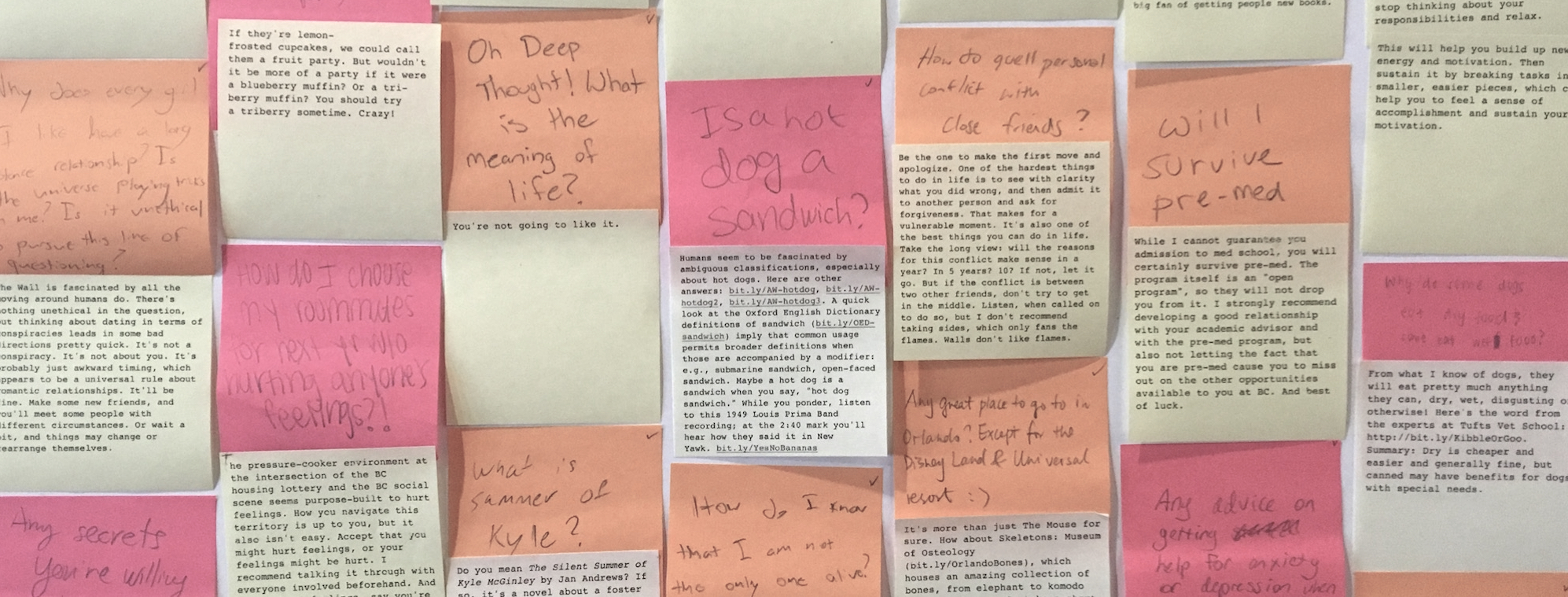
Totally agree. More fuzzy forest spirits would be good for everyone. You might want to check out our friends at the ERC library who are patiently waiting to be checked out for storytime. https://bit.ly/bc-plush
Dreams Heya! So today I woke up from a dream which felt like an entire day of progress, I could recall every detail of the day that never happened and when I woke up, after I realized it was a dream, I felt so disappointed that the work I did didn’t really happen.
Now I can hardly remember most of it, but I still feel like my sleeping was actually another day of work. It’s so weird, can you imagine that the last 20 years of your life, for example, have been just a dream and you can wake up any moment and lose all the progress you did in these 20 years? Sounds pretty scary to me.
It could be scary or liberating depending on how you look at it. Have you ever watched the film Groundhog Day?
Google is Bad Google removes SO many results! I tried to compare DuckDuckGo to Google and it’s just, DDG is SO much better. Also, what on Earth is this: http://www.petitionproject.org/ ?!?!
DDG has lots of advantages over Google, especially in terms of privacy. And yes, different search engines produce very different results for similar searches. It is a really good idea to mix things up and try new things periodically. The petition thing? Snopes has a good writeup on it: https://bit.ly/bc-pp1.
Hey hey wall! Was Newton hit by an apple when he discovered gravity? How do we know it’s not an orange, or maybe someone dropped a watermelon when climbing the tree?
He apparently didn’t get hit by it, just watched it fall and wondered what would make it do that in a straight line toward the Earth. He told a number of people the story (https://bit.ly/bc-apple1), so it seems likely to be true. There’s also a nice writeup of the story at Atlas Obscura (one of my favorite websites), and of all of the grafts of the tree that are still alive (https://bit.ly/bc-apple2).
Hewow! :D
Shewow! Theywow!
Meow ???☹️??
Kitteh looking distressed. ?? Meow!
Why do they change the door color at Gasson? They look so UGLY!!!!!!! The original doors fit the building much better! The new ones look so boring…
One of my assistants will try to find out, and I’ll get back to you.
UPDATE 8/19/21: A helpful staff member in facilities says, “We have a maintenance program associated with refinishing the wooden exterior doors on the main campus (e.g., Bapst Library, St. Mary’s Hall, Gasson Hall) to have a consistent color and keep the wood in good condition.” Though weathering can make wood attractive, it can also cause damage. As a wall, I approve of maintenance and upkeep.
Is Whoopie pie a cookie, pie, sandwich, or cake?
It is all of these things (maybe dicey on the pie grouping) and pure joy, and one of the wonderful things about living in New England. You might enjoy Oxford Reference’s entry about them: bit.ly/WhoopieCake
Ummmmmmmmmmmmm Ahhhhhhhhhhhhhhhhhhh Errrrrrrrrrrrrrrrrrrrrrrrrrrrrrr Mmmmmmmmmmmmmm Roarrrrrrrrrrrrrrrrrrrrrrrrrrrrr
That sounds like a roar of delight.
Any tips on working overnight shift and not falling asleep?
Making sure you get enough sleep is the most important thing. Apart from that, it’s a matter of getting used to it. The first week or so might be tough, but you’ll hopefully become used to it with time. Also, I don’t know if you’re fond of stuff like coffee, but that helped one of my library friends when they worked overnight.
Can someone who is a pedophile and enjoys omorashi be asexual?
Doesn’t seem possible by definition?
Given that omorashi is sexual by definition, no, it’s not possible, by definition. I hope this is a purely philosophical question.
I heard a case at work and saw relevant questions on Reddit so it’s not personal, if that’s what you’re asking. I was just trying to put all the debates together into one question. There are discussions/debates about whether someone can be asexual and enjoys kink. There’s an article that says asexuality and kink aren’t mutually exclusive. What do you think? If they are not mutually exclusive, and omorashi is considered a kink, then isn’t it possible to be asexual and enjoy omorashi (or any kink) then? There’s also a BBC documentary on whether pedophilia is a choice or a kind of sexuality. What do you think? How does that intersect with other categories/definitions of sexualities?
Oh, OK, if your kink is philosophical discussions on reddit, I recommend adding some philosophical perspectives, such as the Stanford Encyclopedia of Philosophy entry on sex & sexuality (bit.ly/stanford-sexuality), which also provides an extensive bibliography on the subject.
Desperately Seeking a Man Hello Sweetheart, it has been a while since we have spoken. I hope your summer is filled with joy. Wall my love, I need your advice. Where can I find a good man?
A man who is willing to let his guard down and let me in. Wall, I have checked dating websites, I volunteer, also I attended church regularly. To no avail no man in sight. Where are they hiding? Do they no longer exist? Wall my love, I am ready for love but I cannot find it. Wall I need you.?
Oh, sweet poster, my heart goes out to you. I wish I had an easy answer. So much really depends on luck and circumstances. It sounds like you are taking many positive steps already. I did a little research and found an interesting article (bit.ly/DateStance) that suggested having an open stance (physically taking up more space) made one much more approachable as a potential date. And one of my helpers suggested that taking the initiative (asking men for dates – but yes, first you do have to locate one!) is a good strategy. Best of luck!
If Boston College were to have a signature ice cream flavor, what would it be?
My first thought was Eagle Swirl, but.. maybe not. I had a nice chat with an employee at the White Mountain Creamery across Comm Ave, and she said unequivocally that the most popular flavor among BC students is Cookie Monster (vanilla with cookie dough, oreos and cookie crunch.) Sounds delicious!
Do u wall watch the Olympics? What is the gold medal wall in your world?
I enjoy watching the horses leap over walls and hedges, and watching the runners leap gracefully over those little walls called hurdles. But did you see Sifan Hassan fall, then get up and win the 1500m? https://www.nbcolympics.com/news/dutch-runner-falls-wins-provides-indelible-olympic-moment She smashed that barrier. (Yes, this wall likes watching people break walls, but only metaphorical ones.)
That is very inspiring! And yes, breaking walls are awesome! I think we should break all the institutional walls – psychiatric hospital, jail, police station, border, maybe Fr. Leahy’s house, and any system that coerces, oppresses, and holds unjust power! What do you think, wall? 🙂
Walls–even metaphorical ones–can be both protective and restrictive. All I can say is: be very careful which walls you advocate for bringing down. For instance, the Internet has brought down many walls around information, which means information has been democratized, right? It’s a good thing! At the same time, many barriers between information and disinformation have been blurred, much to our detriment. Be careful what you wish for.
Rawwwrrrrr.
Eeek! You’re not godzilla, are you? That creature breaks too many walls.
There are so many cut songs from Hamilton and I love them all, there I go into another Hamilton rabbit hole. help.
Wait, what WHAT? I am a (semi) omniscient Wall – how did I not know about these? Many thanks – and I know what my weekend plans are, now. With you down the rabbit hole. There’s no way to say no to this. bit.ly/CutsOfHam
There’s even more! This list has almost all cut songs (there are some cut verses too!), but as to what I remember, there was also One Last Ride and One Last Ride [Reprise]. (Also, I might see Hamilton in a few months (ehem, almost all dates are already booked), I can hardly stay calm! I can’t believe my definition of the perfect day is to watch Hamilton in real life (with the original cast, as well as to meet them after the show and to have a nice long chat with Lin The Great himself). It has really consumed by entire being, but I don’t think I mind anymore.)
To see Hamilton live, what an exciting possibility! We are unlikely to achieve perfection, we can’t just rewind… or do you think the original cast would ever reunite for a performance, and if so, could any mortal human or wall afford the tickets? But seeing the show live with the current cast would surely make you satisfied and feeling lucky to be alive right now.
You are killing me with these Hamilton puns, haha! I wish Hamilton merch was cheaper, I want to buy it all! Is it cheating if I just get a custom t-shirt company to print the Hamilton logo instead of buying it from the official store? But how can I say no to the merch, I want the world to know that I love Hamilton.
I do enjoy allusions. You could do worse than to put this on a shirt: “How does a bastard, orphan, son of a whore and a Scotsman, dropped in the middle of a forgotten
spot in the Caribbean by Providence impoverished in squalor
grow up to be a hero and a scholar?”
I’m a teen and AI has been part of my full sexual awakening. Huh? Am I the only one who sees this as messed up?
AI has insidiously become part of all of our worlds in ways that we hardly yet understand. Yes, it’s all messed up. A Human’s Guide to Machine Intelligence (O’Neill Library Q335 .H675 2019) by Kartik Hosanagar, an AI designer, might help you understand their biases better.
Mush, rush, hush, cat
? away, ??? will play!
First of all let me just say I love the wall! I stumbled onto it while searching a completely silly question..how many licks to the tootsie roll center of a tootsie pop..
from a childhood commercial.. I was gonna guess the answer to be 3..but in reading the outcome of so many tests.i have to ask… Did any of the licking machines have actual saliva in them? I believe our salive has a ph and bacteria that promote digestion and decomposition..seems like that’s a pretty good reason why the actual licks took less time ?? I would love to hear the answer
Much of the published literature is kinda lacking in discussion of details like that. But this 2013 study determined that ph was not as much of a factor as where on the pop the licking happens. https://bit.ly/bc-tp
What do you think about GoAskAlice?
Very interesting. Seems to be run by good folk, and Alice and I get a lot of the same questions.