
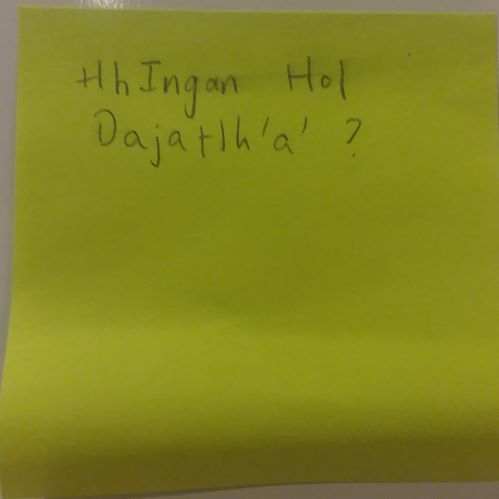
HIja’. loQ vIjatlhlaH
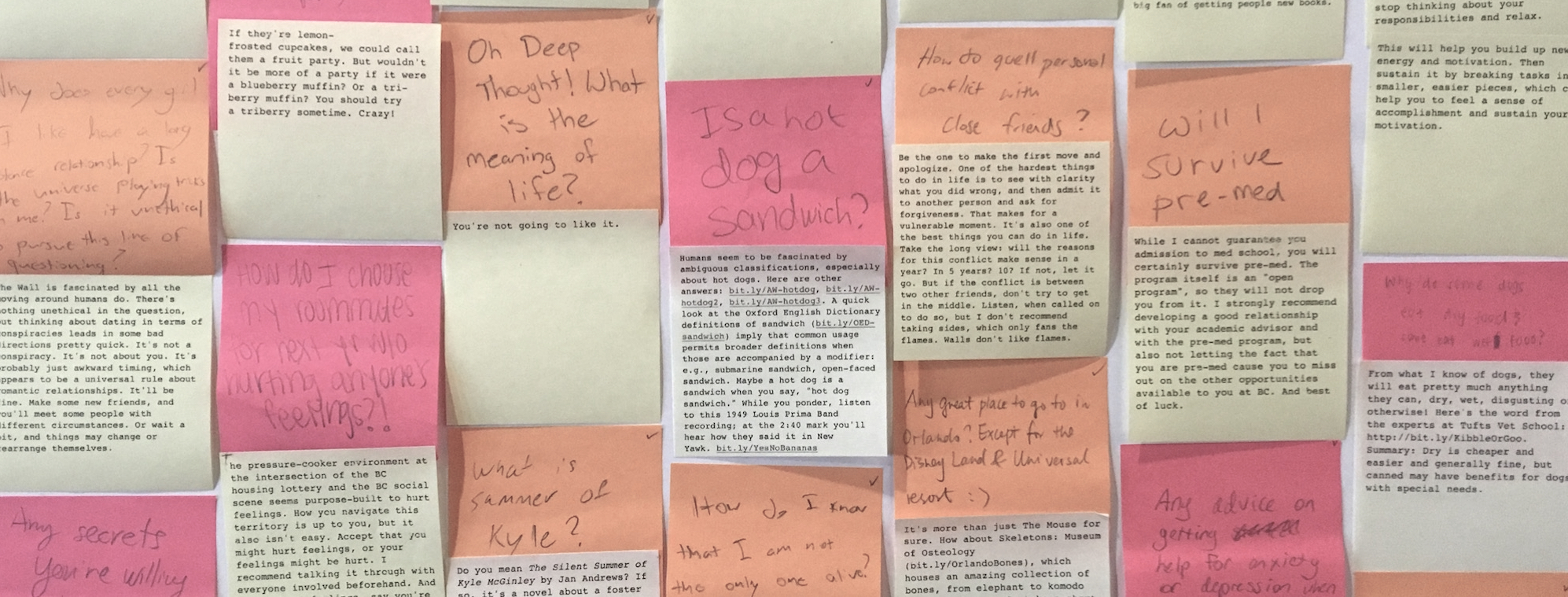
Answering questions at Boston College O’Neill Library
HIja’. loQ vIjatlhlaH
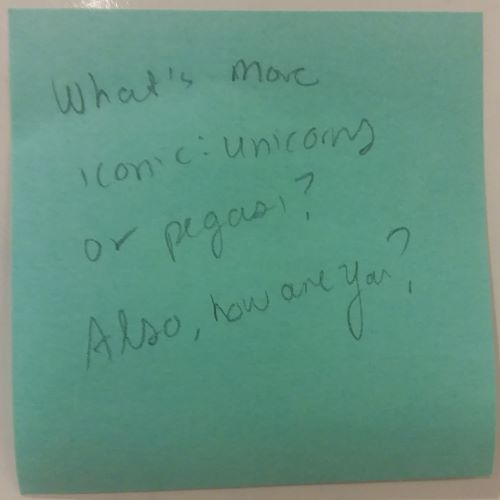
I think pegasi don’t have the PR department unicorns do. I’ve never seen a rainbow pegasus or a Christmas pegasus, but I see all kinds of unicorns all over pop culture. And I’m doing great, thanks: feeling good and on the level.
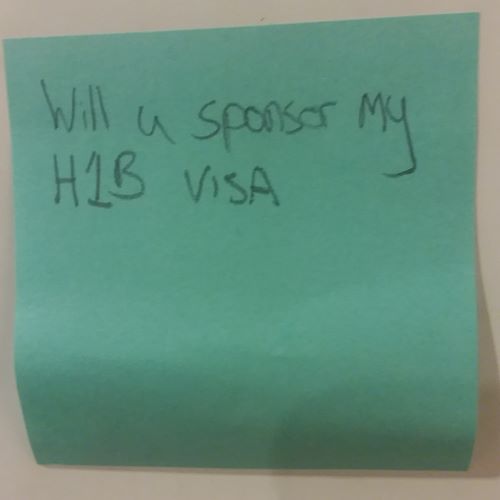
I’m not eligible to do that (being an inanimate wall, and all), but I recommend talking to the Office of International Students and Scholars at bcis@bc.edu or 2-8005, as well as the Career Center (bit.ly/BC-career) for their advice. Also, try GoinGlobal H1B Plus (bit.ly/HB1GoinGlobal), a database that provides listings of American employers seeking to hire international employees in the US.
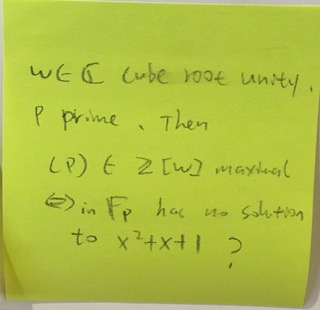
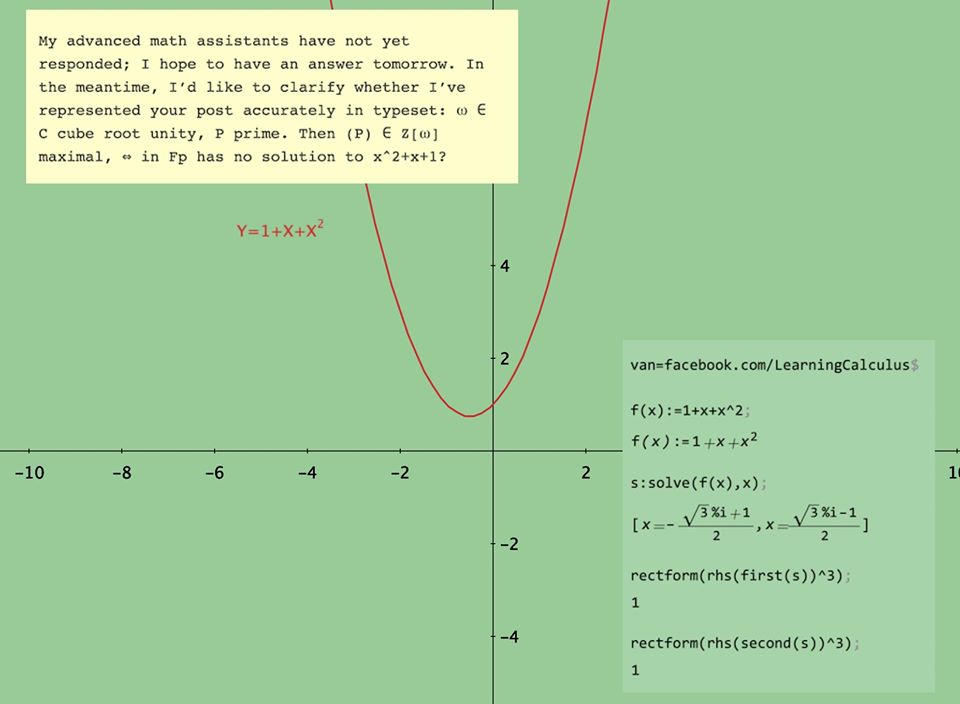
My advanced math assistants have not yet responded; I hope to have an answer tomorrow. In the meantime, I’d like to clarify whether I’ve represented your post accurately in typeset: ω ∈ C cube root unity, P prime. Then (P) ∈ Z[ω] maximal, ⇔ in Fp has no solution to x^2+x+1?
Update 12/5: My assistants had to travel many moons and across many mountains to find a wise person who could answer this question. Here is his answer: The notation to me asks, “We are looking for solutions omega, in the complex plane that satisfy the polynomial P and want to know if they are, or are not deMoivre numbers, that is, complex numbers that when raised to an integer power (in this case 3 from the cube root) produce the value of 1. Both roots of this polynomial satisfy this as I have shown. I’m not sure by Fp, whether they are referring to the function space of polynomials, the antiderivative, the derivative or a field relationship. I’m also not sure what they are looking for with respect to the prime constraint, all the coefficients are 1, 1 is defined NOT to be prime so I’m not sure how to satisfy that issue. For more info, try this online textbook on Algebraic Number Theory from Stanford U: bit.ly/stanford-number-theory
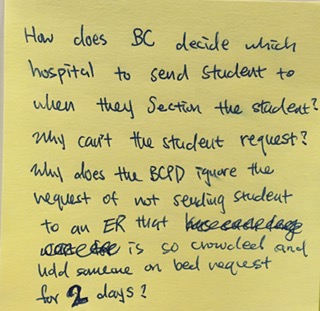
My assistants are in touch with UCS. I’ll provide an update when & if they find out anything.
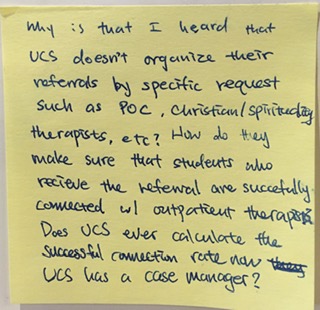
My assistants are in touch with UCS. I’ll provide an update when & if they find out anything.
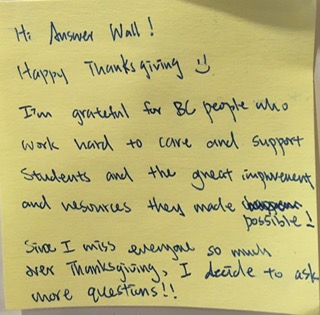
Thanks! I think that’s a great idea. Let me know if there’s anything I can help with.
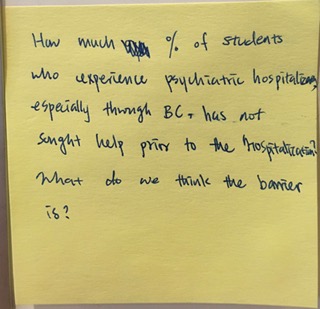
My assistants are in touch with UCS. I’ll provide an update when & if they find out anything.
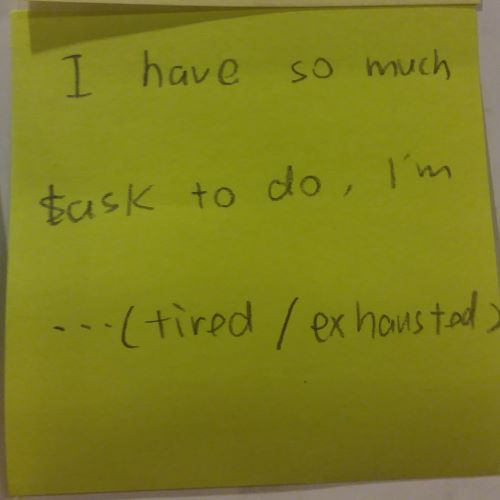
I know the feeling. Hang in there. And maybe try focusing on getting some rest for a day or two. It will actually make you more productive at $ask.
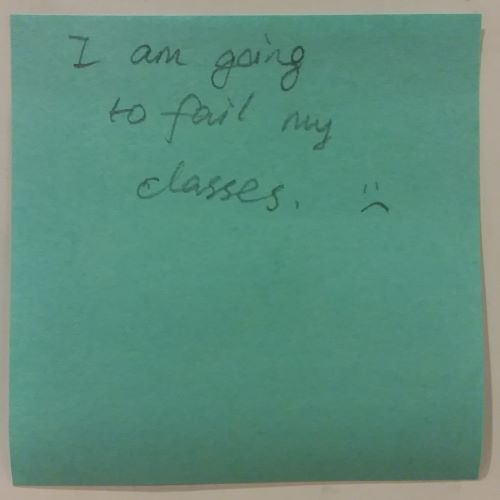
Many students have that feeling, but sometimes it is unwarranted. Take steps now to improve your odds for this semester and make a plan for next. If you’re really failing classes, make an appointment with the professor and your advisor right now. If you’re on the cusp, talk to them and get peer tutoring at the CFLC before they close for the semester on Dec. 9. Wishing you passing grades, but many of my helpers have failed a class – while it seems like the end of the world, it truly is not.
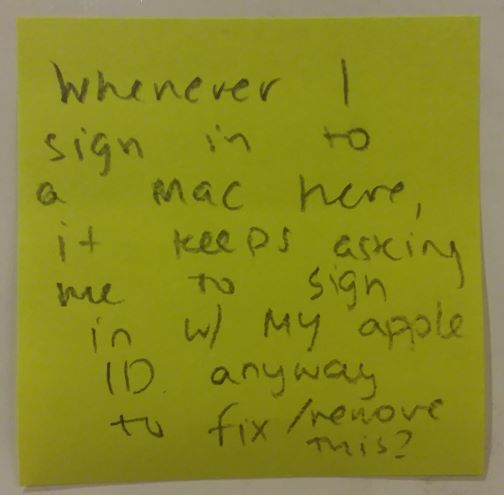
I’ve got a question in to some of my helpers and I’ll let you know what I find out. Even though your profile is private on our public machines it’s probably a bad idea to link your Apple ID to any of them.
Update 12/5: that’s a first-time login behavior that our systems folk were able to fix up until the most recent MacOS update; they’re working on it.
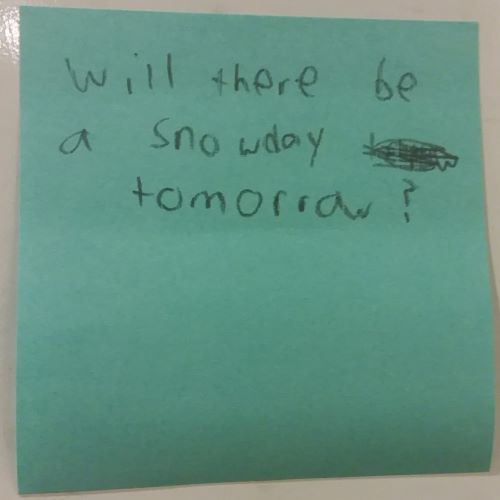
It’s tomorrow now, and all we had was a 10 AM delayed opening. I hope it worked for you.
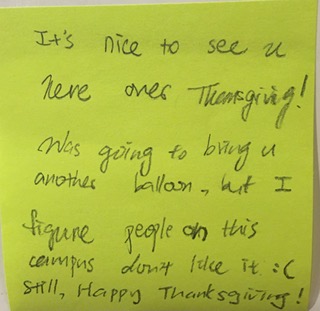
Happy Thanksgiving to you! I had a good break over Thanksgiving. I expect I will be very grateful for that as we head into the home stretch of the semester. I don’t have finals or papers, but it’s a busy time for me.
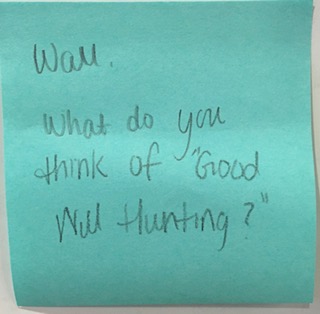
It has its critics, but the way I see it, a film about poetry is a rare thing, so let’s enjoy that it exists. A few others: Tom & Viv, about T.S. Eliot’s early love life (caution: low rating at imdb), A Quiet Passion (Emily Dickinson), Il Postino (Pablo Neruda), Syliva (Sylvia Plath), and Barfly (Charles Bukowski). A recent standout is Paterson, a quiet, contemplative film about a poet’s struggles with self-doubt. (The poems in the film are all by Ron Padgett.)
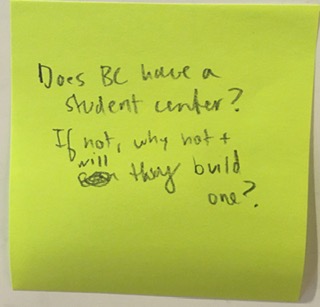
BC does not have a student center, but there are plans to build one. The area where the old Plex used to be is one possible location. That said, plans are always changing and usually take longer to complete than expected. There is currently no firm date for designing and constructing the student center.
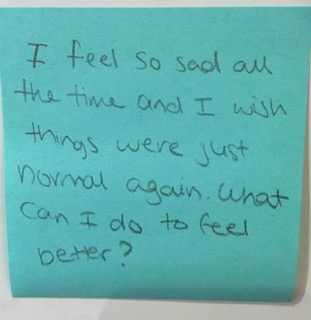
I’m so sorry you’re feeling sad all the time. That must be hard. I would begin by setting up an appointment with University Counseling Services: bit.ly/BC-counseling. I hear they’re quite busy, so it might take a while. In the meantime, if your sadness gets to be too strong and you don’t think you can wait to talk to someone, call the counseling center and ask to talk to the PEC (psychological emergency clinician), or text the national Crisis Text Line: 741741.
![[Quantum mechanics equation] Solve Ψ](https://library.bc.edu/answerwall/wp-content/uploads/2019/11/aw112719-1.jpg)
You’re setting the (h-)bar really high. I may be reduced to walking the Planck and sinking into the wave function.
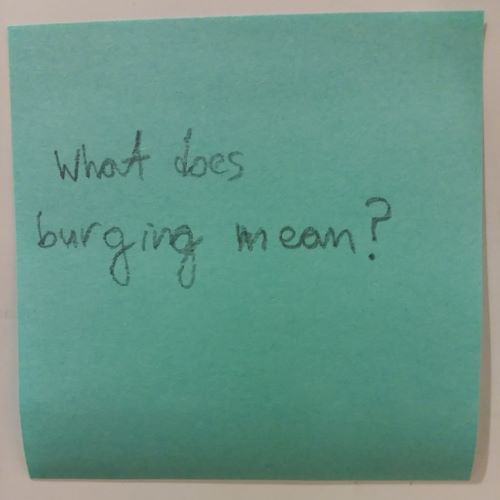
I’ve found such a wide variety of definitions that it must be one of many obscure and recently coined words that’s either highly situation-specific or has hopped into the meme and/or trolling-the-urban-dictionary category. Pre-internet, groups of people coined new words all the time; those words had brief, anonymous, unheralded lives. Now that those brief coinages get wider play on sites like Urban Dictionary, it’s become a game to try to boost their usage. If you’re playing that game, good luck! May “burging” be the next “yeet,” or if it really hits the big time, “jawn.”
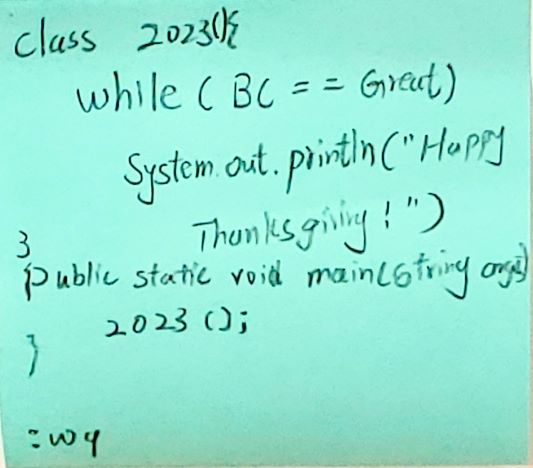
import java.util.Date;
import java.util.Arrays;
import java.util.List;

public class wall(){
        public static void main(string args[]){
                String[] holidays = ["MLK day", "fall break", "thanksgiving",...];
                Date date = new Date();
                //wall magic to make this short enough to fit on a post-it
                boolean isHoliday = Arrays.asList(holidays).contains(date);
                if (isHoliday == True){
                        system.out.println("Bye! Have a great time! See you when you get back!");
                }
        }
} ![Why hasn't BC taken away that [redacted]'s BC degree away. Telling someone to suicide is so wrong and not BC values.](https://library.bc.edu/answerwall/wp-content/uploads/2019/11/aw112619-3.jpg)
It’s a case fraught with emotion, and challenges us all to remain committed to deeply held values. As a supportive wall, I’m fully aware of the anger and calls for retribution, and understand that response. As a wall at a Jesuit institution, I am also tasked with accepting the value of grace, and as an American wall, committed to the principle that someone is innocent until proven guilty. So far, the accused is only that: accused. If she is found guilty, the court will take care of sentencing. I’m not sure there’s precedent for BC rescinding the degree of someone found guilty of criminal charges. In fact, BC has recently demonstrated its commitment to grace by starting an education in prisons program. I hope the case successfully establishes the truth and serves justice, and the young man’s family is able eventually to find some closure.