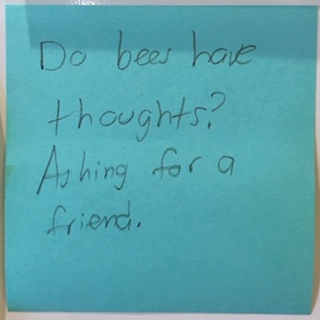
It depends on how you define “thought”. Bees have demonstrated behavior that goes beyond instinct. They can solve experimental problems never encountered in nature. They make decisions based on an effort/reward calculation. They communicate what they learn to each other. But has a bee ever wondered whether to be or not to be? That is a very good question.
いま、なんじですか。(What time is it now?) [Response: 안녕하세요 잘 가 (Hi, how are you? Good bye.)]
“Now” just keeps moving, so answering “What time is it now?” is a challenge for me. Now that I’m finally providing an answer, “Now” has already turned to “then.” I think the response of your Korean friend (“Hi, how are you? Goodbye.”) sums up the concept nicely: What time is it now? Time to say hi, time to say goodbye. “Now” behaves that way all the time: “Hi! Bye!” Now and then I just want Now to slow down and sit in those comfy chairs right over there and pass the time with me.
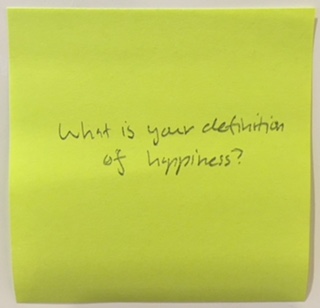
I am truly happy to be in the moment: just being here and supporting the library and watching busy people go by and especially answering questions. What makes you happy?
There was a conference about that a couple of years ago and a number of prominent scientists and philosophers weighed in: bit.ly/bc-cs1. You can look up their work in the library catalog or articles search. The article by Bostrum mentioned there is here: bit.ly/bc-cs2. If you want to dig a little deeper, discussions of the nature of the physical universe usually go under cosmology–here’s an article which covers scientific and philosophical positions equally: bit.ly/bc-cs3
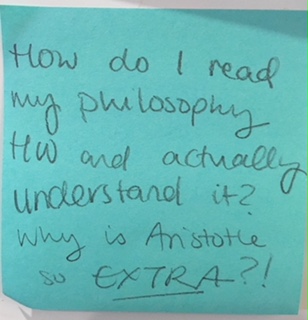
How do I read my philosophy HW and actually understand it? Why is Aristotle so EXTRA?!
Aristotle can be tough, partly because some of what we have of his is kinda like lecture notes. I’m told he’s much clearer in Greek…but assuming that isn’t feasible, here are a few things you could try. 1) Try a different translation–we have lots of all of his works. Sometimes that can make a confusing passage make more sense. In addition to reading the Aristotle, you could 2) Try reading something that tries to summarize Aristotle, like this Very Short Introduction to Ancient Philosophy. bit.ly/bc-vsi, or a general history of western philosophy. 3) Mortimer Adler’s Aristotle for Everybody was written for exactly this reason. bit.ly/bc-aristotle-everybody.
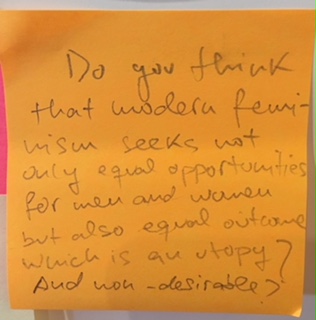
Do you think that modern feminism seeks not only equal opportunities for men and women but also equal outcome which is an utopy and non-desirable?
No. The aims of modern feminism, judging by the 3,420 results in a catalog search using “feminism” as a subject (bit.ly/BCLIB-feminism), cannot be summed up so briefly.
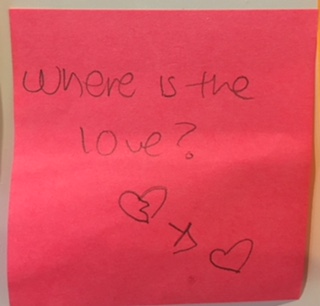
It is sad that we are still reflecting on that question and I wish I could provide the one and perfect answer. Perhaps the best advice for us all is found in the song (bit.ly/whereisthelove2016): “Take control of your mind, just meditate And let your soul just gravitate to the love So the whole world celebrate it” <3 <3 <3 <3 <3 <3 <3 <3 <3
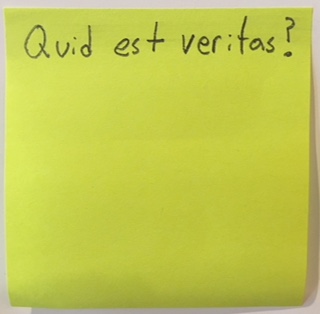
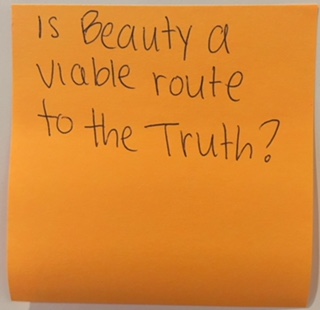
It all depends on your definition of “beauty” and “truth”, and also on where you apply the formula. John Keats’ famous declaration “Beauty is truth, thruth beauty” works perfectly well in the realm of poetry. I am not sure it would work flawlessly in areas such as Politics, Social Sciences, Mathematics or Religion.
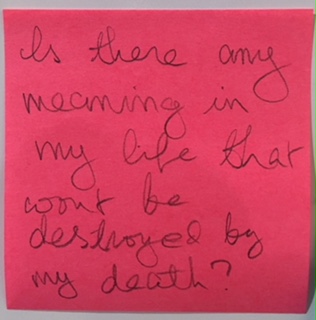
Is there any meaning in my life that won’t be destroyed by my death?
Absolutely. Every day your actions affect others, and every day is an opportunity to make your interactions with others have meaning. Maybe I’ve been listening to the Hamilton soundtrack – available at Course Reserves, O’Neill 3rd Floor – too much (is that even possible?), but if you are interested in your legacy, it makes good food for thought.
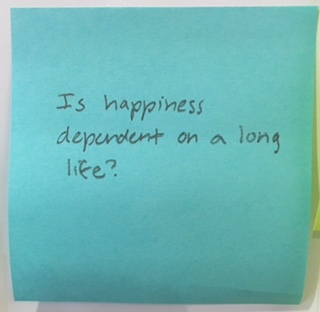
I don’t believe that happiness is dependent on a long life. Instead, I believe happiness is dependent on a fruitful, meaningful life. As Lao Tzu said: “The flame that burns twice as bright burns half as long.”
What is the meaning of life? [Answered] The meaning of life is that you are someone else’s meaning of life 🙂
Truth is I can’t tell you what your meaning of life is; I think we all need to figure it out for ourselves. Did you know that a search of the phrase “meaning of life” in the library catalog produces 244 results? A lot of people are trying to figure this out. This online book provides one short introduction (bit.ly/meaningoflifeintro). And this book provides some different perspectives for you to think about (bit.ly/meaningoflife2). And then there’s always the Monty Python take on it: PN1997 .M424 2003 (but checked out right now, alas).
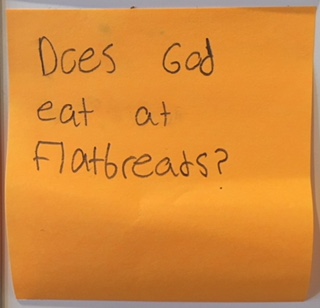
Flatbread is unleavened, right? (More seriously, thinking of God in human terms is called anthropomorphism and it’s an interesting theological problem. More discussion here: bit.ly/bc-flatbread).
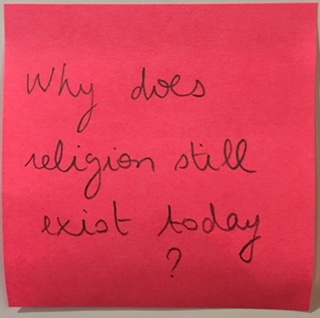
The search for meaning and truth will exist long after our material existence ceases. Victor Frankl’s book, Man’s Search for Meaning, may help you understand why the Human heart longs for more. This book is currently available at O’Neill Library, or the Theology and Ministry Library at call number D810 .J4 F72713 [1985 or 2006].
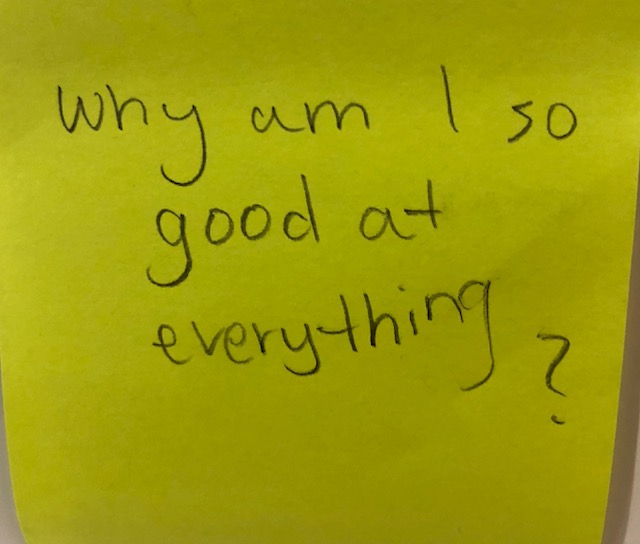
I’m so glad everything is going so well for you! I’m always impressed by how talented BC students are, so it is hardly a surprise! Now that you have achieved success at everything you try, I would encourage you to consider two things. First, how can you be a supportive friend and classmate? This might mean serving a cheerleader for your friends or offering to serve as a tutor for those who aren’t having as easy of a time at it. Second, think about whether you might want to challenge yourself more. Are you good at everything because you are avoiding things that seem scary or difficult? If so, maybe you could set yourself a goal of trying one thing that seems interesting but potentially challenging. It’s a great way to avoid boredom and making sure that you aren’t missing out by playing it safe.
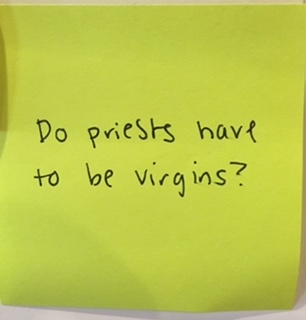
There’s a long church history on the question of celibacy and the clergy, some of which you can see in the New Catholic Encyclopedia: bit.ly/bc-celibacy. The early Church and Eastern Christianity had/have married clergy, and the Western Church recognizes them as priests. bit.ly/bc-celibacy2. Saint Augustine, prior to being a priest and then bishop, was apparently sexually active. (Confessions book 3, chapter 1): bit.ly/bc-celibacy3. So no, virginity is apparently not a requirement, but a vow of celibacy is. The Wall has reached out to other walls on campus for additional comment.
In Being and Time what does Heiddeger mean when he says Dasein is “being-in-the-world” ? Approx 2 pages for a response please
The Wall salutes your entrepreneurial spirit, but doesn’t have that kind of space. For a technical answer, you might try the Stanford Encyclopedia of Philosophy: bit.ly/bc-dasein1. You could also look at something like the Cambridge Companion to Heidegger: bit.ly/2ry9wPo. Both will have lots of suggestions for further reading. Ask the humans at the reference desk if these don’t do what you need.
Can you separate an artist’s work from their beliefs? Can you separate different parts of a person’s moral character?
Those are not easy questions to answer. The Wall is feeling a little ancient today, so it will start by recommending Plato’s dialogue Ion, in which Socrates interviews a poet to determine whether he’s an expert on what he writes about. bit.ly/bc-ion. Ancient ethical theory tended to think of virtuous people, where modern thought tends to think of virtuous actions, so it kinda depends on who you ask. bit.ly/bc-ethics. More immediately, you might be interested in reading Molly Ringwald think through her complex reactions now to the movies she made with John Hughes. bit.ly/bc-metoo.




![What is the meaning of life? [Answered] The meaning of life is that you are someone else's meaning of life :)](https://library.bc.edu/answerwall/wp-content/uploads/2018/09/aw090418-7.jpg)