
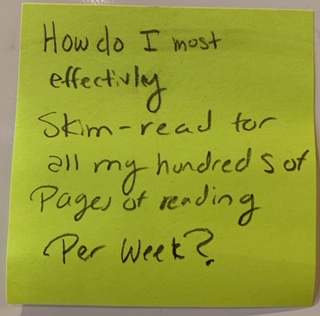
I sound like a broken record today, but do contact the Connors Family Learning Center (bit.ly/BC-connors) about academic coaching to learn to develop ways to read/study in a more effective manner.
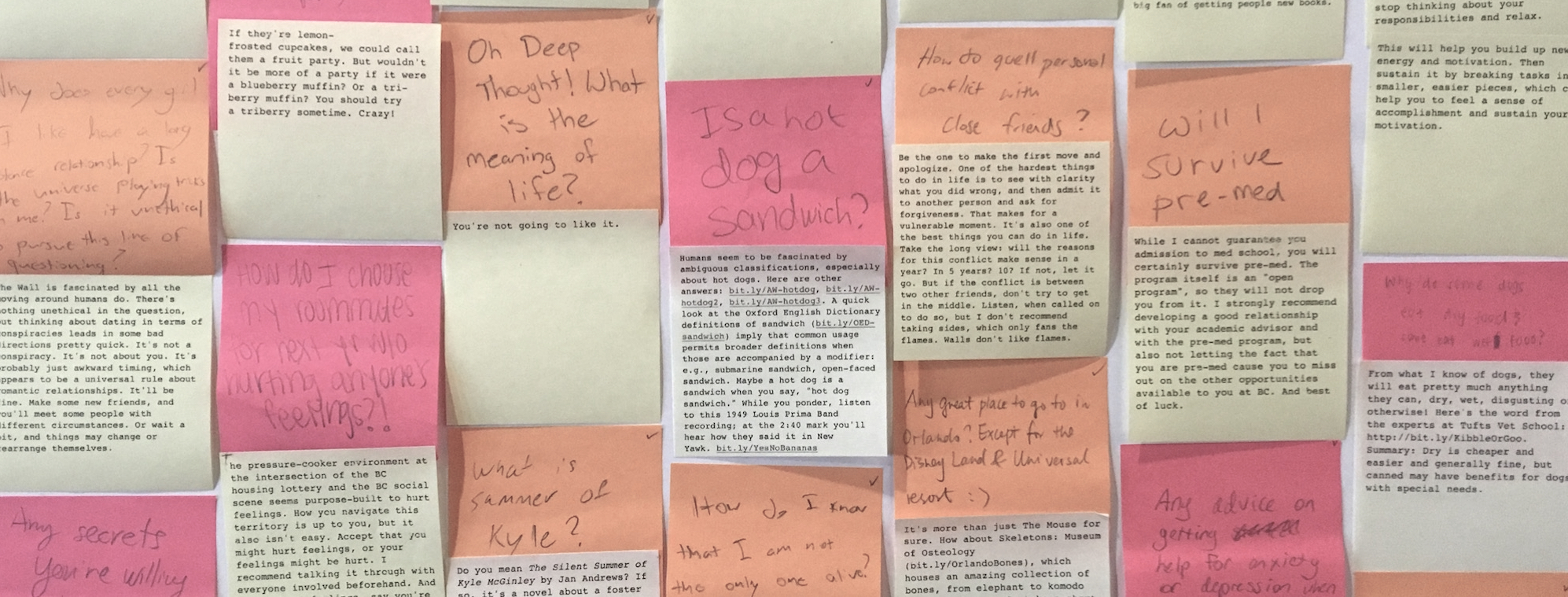
Answering questions at Boston College O’Neill Library
I sound like a broken record today, but do contact the Connors Family Learning Center (bit.ly/BC-connors) about academic coaching to learn to develop ways to read/study in a more effective manner.
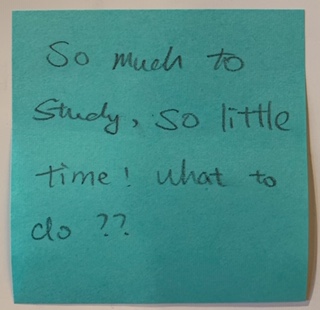
I highly recommend the Connors Family Learning Center’s Academic Coaching (bit.ly/BC-connors) – it’s exactly for learning to deal with this.
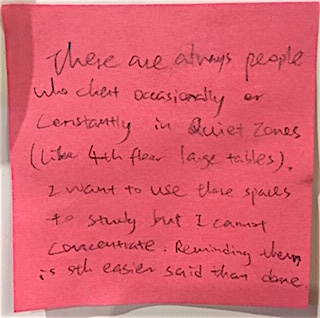
I’m sorry you’re encountering this problem; it must be frustrating to seek quiet spaces, and find that those spaces are not, in fact, quiet. I will let my assistants know. Thanks for making some noise about the noise!
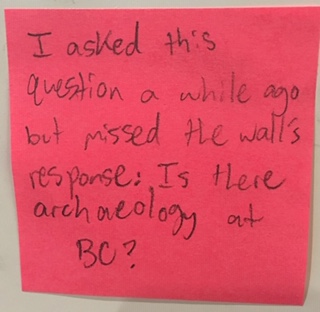
The answer was “There is at least one: Gail Hoffman in the classical studies department.” But don’t worry about ever missing my answers – my little Post-It friends only hang out with me until I get too cluttered, but you can always read all my answers on my blog! (library.bc.edu/answerwall/)
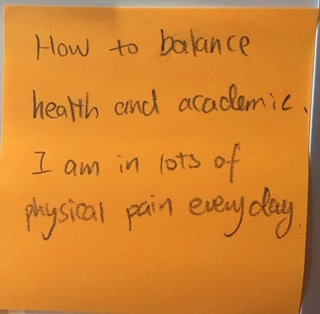
Inside Chronic Pain (bit.ly/BC-inside-chronic-pain – click on Books at JSTOR) by Lous Heshusius, provides a first-hand account of 10 years of treating her chronic pain and talks about the importance of rooting oneself in the present. Another book, Mayo Clinic on Chronic Pain (bit.ly/mayo-chronic – click on EBSCOhost eBooks) provides strategies for finding the balance you’re looking for. I hope you’re using accommodations available to you under ADA rules; contact Disability Services (disabsrv@bc.edu) if you haven’t done so already. Your day-to-day efforts are truly heroic; make sure you let folks help you.

Great idea! Too late for this semester, but worth exploring if you still need to take Perspectives in the future.

Look no further than BC’s mission statement (http://bit.ly/bc-mission-history), part of which reads: “Boston College remains committed to leading its students on a comprehensive journey of discovery—one that integrates their intellectual, personal, ethical, and religious formation.”
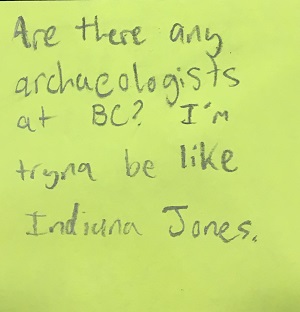
There is at least one: Gail Hoffman in the classical studies department. I think you’ll find that she is, like most archaeologists, more meticulous & precise than swashbuckling.
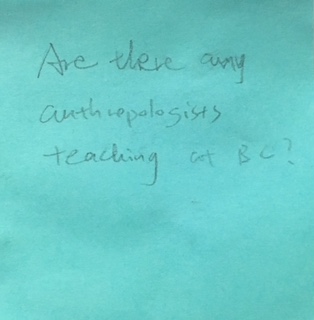
Yes, there are! Faculty members in the Lynch School of Education, Patrick McQuillan, Ph.D., and Gabrielle Oliveira, Ph.D., have backgrounds in anthropology. And Theology Department faculty member Mary Ann Hinsdale, Ph.D., teaches Theological Anthropology (THEO 796801).
Isabelle Stone (’18) was awarded a Rhodes Scholarship. (bit.ly/bc-rhodes-issa) Congrats, Issa! What an achievement! It’s the first Rhodes awarded a BC student since 2003. At Oxford University she’ll be studying how to put her economics data knowledge to work to design public policy to help advocate for marginalized people.
(I know, I’m responding to something that wasn’t a question, but I just couldn’t help myself. I was bursting with the news!)
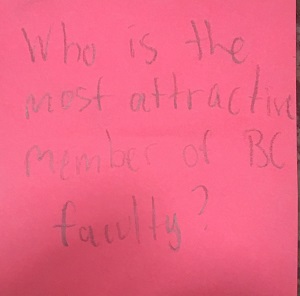
There are many scales of attractiveness. The faculty member most attractive to an institution of higher learning is very likely the one with the most prestigious grants, fellowships, awards, and publications. A Nobel Laureate would be the academic equivalent of a Perfect 10. BC has only ever had one of those among its faculty: the Irish politician John Hume, who won the Nobel Peace Prize for his role in the Northern Ireland peace process. As for current faculty, Juliet Schor is making waves in sociology & environmentalism, Elizabeth Graver and Paul Mariani are esteemed authors, and Amir Hovyeda is a star in chemistry. Many more than can fit on a 3×3 post-it!
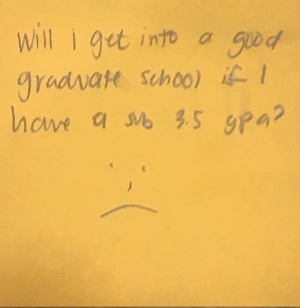
Undergraduate GPA is not the only consideration for graduate school admissions. Generally speaking, if you have a lower than average GPA (for the school you’re interested in), you will have to distinguish yourself through “soft factors” such as life/professional experience. You may consider working for a few years to distance yourself from your undergraduate GPA and build up professional experience to bring to your desired program. I believe in you!
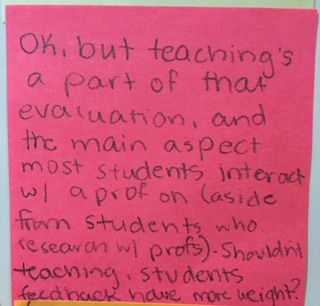
The Wall does not judge the system, only describes it.

It’s possible, but not easy. “Boston College undergraduate students may apply for internal transfer to the Carroll School of Management for the spring of their sophomore year. The Carroll School accepts a very small number of internal transfer students via a lottery process.” See full details at bit.ly/CSOMtransfer
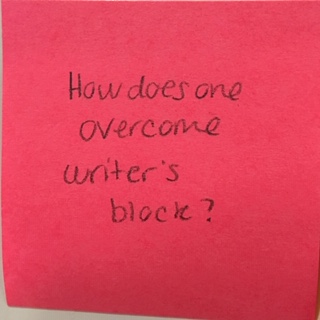
Writer’s block is usually a result of your internal editor being adjusted louder than your internal creator. When your internal editor says “not good enough” too often or too loudly, preventing you from getting the words in your head onto the page, tell your internal editor, “It’s a good start. I can change it later if I need to.” Just keep repeating that until it’s louder and more persistent than your internal editor. I also recommend reading Anne Lamott’s Bird by Bird (O’Neill Library PN147 .L315 1994).
![6 hrs to dd --- when you're tryna finish work as the deadline comes up [drawing of dotted line across neck of child]](https://library.bc.edu/answerwall/wp-content/uploads/2018/12/aw121418-5.jpg)
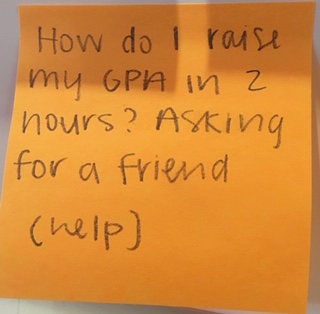
By the time you read my response, you’ll be done. I hope it feels really, really good! Celebrate being done – and maybe next semester level up on your time management skills with academic coaching at the CFLC (bit.ly/BC-connors)?
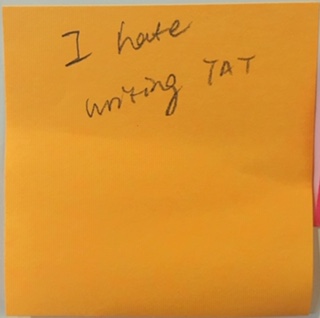
Most writers would agree at one time or another. If you take it seriously, writing is really, really hard. Most writers go through many revisions & get lots of input on their way to a finished piece. If you think about it, it’s a weird behavior: you put marks on a piece of paper that some other people will decode into words. You have to anticipate all manner of possible interpretations and misinterpretations & account for them ahead of time, not really knowing for sure what your words will mean to someone. That’s double-black-diamond communicating. To do it well takes a whole lot of practice. You have my complete sympathy! And I think you’ll master it.
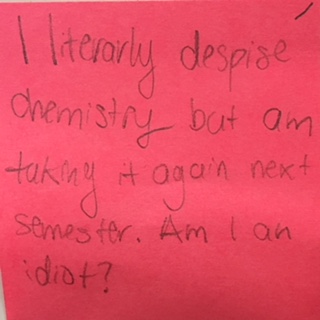
Far from being proof of idiocy, your persistence in the face of adversity is admirable and scholarly. Perhaps you are taking chemistry for a major or pre-professional requirement. Maybe you’re just trying to prove something to yourself. In any case, I wish you the best with it. Do visit the CFLC (bit.ly/BC-connors) for peer tutoring whenever you need assistance.
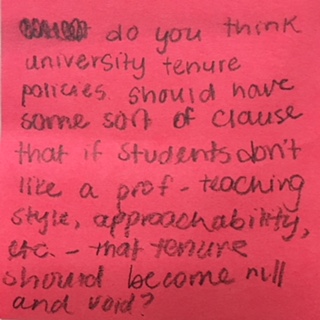
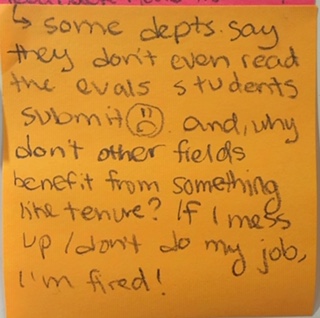
Faculty are evaluated on research, teaching, and contributions to the university and the scholarly community. Student feedback and evaluations are part of that. bit.ly/bc-faculty-bylaws. Tenure was designed to protect faculty from being fired for not being popular with donors or governments, so whether students “like” a professor seems potentially like a similar issue. More info on tenure and why it’s useful: bit.ly/bc-tenure.